
Showing posts with label Global Warming. Show all posts
Showing posts with label Global Warming. Show all posts
Thursday, December 31, 2009
How Cold Is It?
Last winter it was cold enough that Al Gore's Only Remaining Audience came out to play. This year it's even colder. Quite a photo to explain!


Monday, July 20, 2009
Rediscovering the Final Frontier
One imagines Gene Roddenberry, Robert Heinlein and Isaac Asimov to be rolling over in their graves at the current state of affairs. Roddenberry emblazoned on our minds the idea of space as our final frontier; that we had it in us as humans to conquer our vast differences in a common effort to expand outward beyond our own small atmosphere in order to maintain ourselves as a species. Heinlein imagined a future wherein space travel and interplanetary colonization were not only possible, but commonplace. Asimov contemplated a future where we had expanded as a species to every corner of the galaxy, finding only ourselves as sentient beings, guardians of our own survival by means of our ability to expand.
The 40th Anniversary of the first moon landing has brought about memories amongst us of those longings to move ever outward from within, and with them, questioning about why, exactly, we find ourselves moving ever inward.
Megan McArdle is nostalgic:
And it seems to me that it's the issue of our depth of commitment to eco-consciousness that has played a role in derailing our space interests. As we hurdle forward with ever more stringent regulation over our emissions, without a full understanding of their effects, we ignore the fact that no matter how much we limit our consumption of this planet's resources, we will eventually run out of everything. As I attended grade-school, I always had this in mind. I was deluged by stories of the necessity of recycling in the Weekly Reader and those were only reinforced in my afternoon cartoons as Captain Planet burst onto the scene as a new superhero. To my mind, it was our responsibility to preserve the planet until such time as we could find ourselves hurtling through that great black void to some as yet undiscovered new home. It always seemed to me, as Heinlein put it, that "The Earth is just too small and fragile a basket for the human race to keep all its eggs in."
But as Heinlein rolls, Conor Friedersdorf sums up what seems to be the current attitude:
Has our eco-consciousness and environmentalism really become so pervasive that our attitude toward the progression of our species as a whole has become emasculated to the point of just being happy to be here? Is the attitude really that we're going to be obliterated at some point so we may as well enjoy it while it lasts?
NASA's budget is about $17.6 billion per year. This represents our commitment to exploring the cosmos and progressing the science necessary to preserve our species. In the meantime, we find ourselves at the brink of watching our government commit more than $31 trillion over the next 90 years to a cap and trade bill that intends only to limit how much we are able to progress the industrial and nuclear sciences that would propel our species into the stars and our future salvation, and to do it absurdly in the name of that self same preservation. That works out, by the way, to a cost to society as a whole of over $344 billion per year.
One can only wonder, if we were to reverse our current self-immolatic attitude of "preservation" through the denial of resources, to one of real preservation through progress, what the future might hold.
Perhaps we might begin again to work toward conquering our final frontier.
The 40th Anniversary of the first moon landing has brought about memories amongst us of those longings to move ever outward from within, and with them, questioning about why, exactly, we find ourselves moving ever inward.
Megan McArdle is nostalgic:
Four years before I was born, man walked on the moon for the first time, the most magnificent single feat our little tribe of East African Plains Apes has ever managed. Now we don't even do that. What happened to the dream? Government mismanagement, yes, but something more than that, too, some failure of imagination and will.Charles Krauthammer does a better job of pinpointing what seems to have happened:
Why do it? It's not for practicality. We didn't go to the moon to spin off cooling suits and freeze-dried fruit. Any technological return is a bonus, not a reason. We go for the wonder and glory of it. Or, to put it less grandly, for its immense possibilities. We choose to do such things, said JFK, "not because they are easy, but because they are hard." And when you do such magnificently hard things -- send sailing a Ferdinand Magellan or a Neil Armstrong -- you open new human possibility in ways utterly unpredictable.
The greatest example? Who could have predicted that the moon voyages would create the most potent impetus to -- and symbol of -- environmental consciousness here on Earth: Earthrise, the now iconic Blue Planet photograph brought back by Apollo 8?
Ironically, that new consciousness about the uniqueness and fragility of Earth focused contemporary imagination away from space and back to Earth. We are now deep into that hyper-terrestrial phase, the age of iPod and Facebook, of social networking and eco-consciousness.
And it seems to me that it's the issue of our depth of commitment to eco-consciousness that has played a role in derailing our space interests. As we hurdle forward with ever more stringent regulation over our emissions, without a full understanding of their effects, we ignore the fact that no matter how much we limit our consumption of this planet's resources, we will eventually run out of everything. As I attended grade-school, I always had this in mind. I was deluged by stories of the necessity of recycling in the Weekly Reader and those were only reinforced in my afternoon cartoons as Captain Planet burst onto the scene as a new superhero. To my mind, it was our responsibility to preserve the planet until such time as we could find ourselves hurtling through that great black void to some as yet undiscovered new home. It always seemed to me, as Heinlein put it, that "The Earth is just too small and fragile a basket for the human race to keep all its eggs in."
But as Heinlein rolls, Conor Friedersdorf sums up what seems to be the current attitude:
But look. Earth is going to be hit by another extinction level asteroid long before the sun is going to burn up. An obligation to preserve the only meaningful life that we know suggests that we spend money on scanning the sky for gargantuan rocks hurtling toward us, safeguarding humanity against pandemic diseases and stopping nuclear proliferation. I'd be thrilled to learn that we'll survive half as long as it takes the sun to burn up!
Has our eco-consciousness and environmentalism really become so pervasive that our attitude toward the progression of our species as a whole has become emasculated to the point of just being happy to be here? Is the attitude really that we're going to be obliterated at some point so we may as well enjoy it while it lasts?
NASA's budget is about $17.6 billion per year. This represents our commitment to exploring the cosmos and progressing the science necessary to preserve our species. In the meantime, we find ourselves at the brink of watching our government commit more than $31 trillion over the next 90 years to a cap and trade bill that intends only to limit how much we are able to progress the industrial and nuclear sciences that would propel our species into the stars and our future salvation, and to do it absurdly in the name of that self same preservation. That works out, by the way, to a cost to society as a whole of over $344 billion per year.
One can only wonder, if we were to reverse our current self-immolatic attitude of "preservation" through the denial of resources, to one of real preservation through progress, what the future might hold.
Perhaps we might begin again to work toward conquering our final frontier.
Monday, June 29, 2009
Sullivan Missing the Point on Waxman-Markey
There is a decent amount of buzz brewing today over a the cost-benefit analysis put together by Jim Manzi on the Waxman-Markey bill. The analysis is very well worth the read and I would suggest reading the whole thing. For those of you unwilling to read it all, the result of his analysis is that:
The left is a-twitter, already rationalizing away the reasons why we can't pay attention to this, and they have a strong guiding hand coming from Andrew Sullivan, who obviously doesn't care for Manzi's results. He links us to Matt Steinglass, who laments the reasonableness of performing a CBA for items which cannot be measured in terms of cost:
Sullivan also links to Rortybomb, who makes a similar argument, describing the Planet Earth itself as being the sunk cost in the CBA:
Both Steinglass and Rortybomb choose to ignore the most important part of Manzi's cost-benefit analysis, and Sullivan, by linking them to back his own agenda, proves that he seems not to care about it either (emphasis mine):
What this means exactly is that the economy as a whole is unlikely to suffer any damage from "global warming" before 2100, therefore we are not expected to enjoy any benefit from the bill for 91 years, and that is only the point at which we might break even. In the meantime, we are all going to be paying, according to Heritage, $4,600 per year for this bill for a family of four. Now, in a crude look, if we say we have 300 million people, and all of them are families of four, so we have 75 million families of four paying an additional $4,600 per year for 91 years, this will be, cumulatively $31.395 trillion dollars paid to stave off what may very well be a ghost, and considering I've ignored inflation of any kind, that's on the low side!
Considering that the science regarding "global warming" or "climate change" actually appears to be far from settled, I am inclined personally to wonder into what crystal ball the likes of Steinglass, Rortybomb and Sullivan are looking that makes them know this bill is possibly worth its cost.
The costs would be more than ten times the benefits, even under extremely unrealistic assumptions of low costs and high benefits. More realistic assumptions would make for a comparison far less favorable to the bill.
The left is a-twitter, already rationalizing away the reasons why we can't pay attention to this, and they have a strong guiding hand coming from Andrew Sullivan, who obviously doesn't care for Manzi's results. He links us to Matt Steinglass, who laments the reasonableness of performing a CBA for items which cannot be measured in terms of cost:
There are two issues here. First, GDP measures income, not wealth. If your house burns down, it will most likely not change your income. Does that mean you should spend nothing to protect your house from burning down? Second, GDP only measures things that can be measured in money. But the worth of many precious things cannot be measured in money: Yellowstone National Park, the independence of one’s country from foreign rule, the existence of elephants and polar bears, clean air, the ruins of the city of Ur, the fact that humans have traveled to the moon, etc.
Sullivan also links to Rortybomb, who makes a similar argument, describing the Planet Earth itself as being the sunk cost in the CBA:
That said, the thing that worries me about the Cost-Benefit Analysis (CBA) approach to this issue is that there is always an implicit “do-over” cost in CBA. If we start a marketing campaign, hire a new team, or build a factory we do a CBA. If it turns out wrong, we simply stop the campaign, lay off the new team, or dynamite the factory. We eat our sunk costs and are back at square one. Sometimes this is costless, sometimes you have to pay for the dynamite. Indeed estimating the cost of this metaphoric dynamite should be high on the list of the CBA.
Now if 100 years from now, we want to “do-over”, how much will it cost to ‘dynamite’ the previous 100 years of warming? How much of GDP will we have to spend to get back an additional 10-20% of biodiversity? I’m worried that we are looking at Planet Earth as the sunk costs in these CBAs, and that makes me very worried, and being very worried makes me more willing to spend. We can’t just jump to another Earth if we got it wrong, in the same way we can build a new factory if our projections were off. This isn’t even tail risk or ‘precautionary principle’ land – we, as managers of Firm Earth doing a CBA, want to know the costs of getting rid of that 3 degrees of warming. As far as I can tell, they will be very, very high.
Both Steinglass and Rortybomb choose to ignore the most important part of Manzi's cost-benefit analysis, and Sullivan, by linking them to back his own agenda, proves that he seems not to care about it either (emphasis mine):
Remember that the U.S. should not expect any net economic damage from global warming before 2100. That is, the bill’s benefits would accrue to U.S. consumers—who are also bearing its costs—sometime in the next century. The EPA underestimate has costs rising from zero to 0.8 percent of consumption between now and 2050, and offers no projection beyond that year; but to what level would costs rise over the more than 50 years between 2050 and the point in 22nd century when we might actually expect some net economic losses from global warming? The answer is likely to be much higher.
What this means exactly is that the economy as a whole is unlikely to suffer any damage from "global warming" before 2100, therefore we are not expected to enjoy any benefit from the bill for 91 years, and that is only the point at which we might break even. In the meantime, we are all going to be paying, according to Heritage, $4,600 per year for this bill for a family of four. Now, in a crude look, if we say we have 300 million people, and all of them are families of four, so we have 75 million families of four paying an additional $4,600 per year for 91 years, this will be, cumulatively $31.395 trillion dollars paid to stave off what may very well be a ghost, and considering I've ignored inflation of any kind, that's on the low side!
Considering that the science regarding "global warming" or "climate change" actually appears to be far from settled, I am inclined personally to wonder into what crystal ball the likes of Steinglass, Rortybomb and Sullivan are looking that makes them know this bill is possibly worth its cost.
Friday, June 26, 2009
Cap & Tax Insanity!
A good, quick video summation of this insanity with Glenn Beck and Peter Schiff. Bookworm has the list of which representatives are leaning which way at this point, and Michelle has directions on how to get your rep's number. It's close as hell. If your rep is undecided or straddling the fence, get on the line immediately with a resounding NO! Melt the phone lines and crash the servers!
UPDATE: NRO is saying it could be pulled...keep the phone calls rolling until it happens!
UPDATE: NRO is saying it could be pulled...keep the phone calls rolling until it happens!
Wednesday, June 17, 2009
The Tyrrany of Cap & Trade
For those of us that keep an eye on the "Global Warming" "Climate Change" "Energy Security" debate, and actually feel like we should know the facts, Lord Christopher Monckton is an undeniable force for common sense in the discussion.
His "Open Letter" to John McCain during the presidential election in October of 2008 remains quite simply one of the most comprehensive and practical arguments against the idea of anthropogenic global warming (AGW) I have ever come across, and is well worth the read for anyone wanting to shore up their arguments in the debate. And he has not stopped there, continuously offering some of the most salient arguments against AGW out there, such that he has even been banned from the debate.
Today we are provided with a fantastic interview with Monckton, performed by Gregory Murphy, Associate Editor of 21st Century Science & Technology where the true intentions of the Marxist Green Left are brought to the forefront.
The entire interview may be found here. Enjoy!
His "Open Letter" to John McCain during the presidential election in October of 2008 remains quite simply one of the most comprehensive and practical arguments against the idea of anthropogenic global warming (AGW) I have ever come across, and is well worth the read for anyone wanting to shore up their arguments in the debate. And he has not stopped there, continuously offering some of the most salient arguments against AGW out there, such that he has even been banned from the debate.
Today we are provided with a fantastic interview with Monckton, performed by Gregory Murphy, Associate Editor of 21st Century Science & Technology where the true intentions of the Marxist Green Left are brought to the forefront.
After establishing who is pushing the argument for anthropogenic global warming, Murphy and Monckton go on to discuss their true intentions.Murphy: In the past you’ve described the global warming scare, fraud, hoax—you’ve used numerous words to describe this—as a “genocidal” policy, similar to the policy of how AIDS was handled, or to the ban on
DDT. Is that still your view?Monckton: What we have here, is a faction in politics, and it’s a worldwide faction, that really came out of the Marxist extreme left when the Berlin Wall collapsed, and found its new home in the environmental movement. And it got into the environmental movement and took it over. A friend of mine is one of the founders of Greenpeace, and he said, “All of us who are genuine environmentalists left after a year, because the Marxists moved in and took it over.”
For all of the scientific argument that is readily made against the faux-science that supports AGW, it is refreshing to find a voice like Monckton's finally speaking plainly about the true intentions of the Green Left. Murphy and Monckton address the hard science in great detail, to be sure, but it is Monckton's blunt approach to the political facts at hand that is outstanding to find. Those of us that have examined both sides of the facts, have all largely been able to deconstruct the science for AGW and find it incredibly lacking. Following Monckton's lead, now is the time to begin to deconstruct the political aspects of AGW, and to expose the environmentalist frauds for what they truly are: Marxist wolves in sheeps clothing.Murphy: That is very true. What is coming out - you’ve identified the biofuels scam as hurting the poor with food starvation, which is listed as one of WHO’s top causes of death. Now, [UN Secretary-General] KofiAnnan has just issued a bizarre, bogus report stating that 300,000 people have died already as a result of global warming or climate change per year, and more deaths are possible. But the policies that he’s advocating to solve this will kill billions of people, and will eclipse that, even if it were true.
Monckton: Let’s look at this report. It’s produced by the usual crowd of rent-seekers wanting to enhance the role of the UN as a world government. That’s what is really behind this: It’s world government that the left are after. And world government, of course, does not mean democratic government. It means autocratic government, rather like the EU writ large. And this report they produced is plainly nonsense, and you can just look at one simple fact, and that is that for the last 15 years, as [MIT climatologist] Dick Lindzen is about to tell us, there has been no statistically significant global warming. For the last eight and a half years, there has actually been a trend of global cooling, and quite a rapid one. So, why is Kofi Annan coming along now, 15 years after the warming stopped—and, of course, the warming was pretty unremarkable even while it was happening; it was entirely within natural variability—but the warming stopped 15 years ago, and only now do they tell us that this warming was killing people. It certainly can’t have been killing people recently, because we’ve been having global cooling. And that one fact is enough to establish what complete nonsense this UN report is. All it is, is another way of keeping this flagging, failing scare in the headlines between now and the Copenhagen Climate Summit organized by the UN for December 2009. And at that summit, they are hoping the first steps to turn the Intergovernmental Panel on Climate Change into a world government will be taken. They are not frankly particularly worried about whether they get a deal on who should cut global emissions by how much. It is not, and never was, about that. It is not and never was about the climate. As Vaclav Klaus, the president of the European Union at the moment, has rightly said, “It’s not about climatology; it’s about freedom.”
They want to take our freedom away. They want to set up a world government which will tell the rest of us how to behave, and which will certainly not be subject to any democratic recall or accountability or constraint. And they will do this by saying that, of course, the peoples of the world if left to their own devices, would screw up the planet, because of the emissions of carbon dioxide. Therefore, to save you from yourselves, we are going to ask your government to hand over their sovereignty and their powers—of course in our democratic countries, their powers are peoples’ powers—to unelected bureaucrats, technocrats, and dictators, so that they will govern us in the future.That is what this is all about, and they have to be stopped, which is why I am here.
The entire interview may be found here. Enjoy!
Sunday, February 8, 2009
Springtime in Chicago

[clicky for biggy]

Yes, a little piece of springtime came to Chicago this weekend. The sky was bright and the air was crisp. And of course with the wonderful 50 degree weather, came all the crap that had been accumulating in, on, and under the ice and snow on the streets.
So the trade off has mostly been asthetics [from afar] for warmth. To illustrate, here's a beautiful shot of the alabaster beauty of winter - taken from inside part of my campus.
[clicky for biggy]

Monday, February 2, 2009

Thursday, January 29, 2009
Why Can't We Just Think?
UPDATE: Great minds think alike.
Now it's been fairly obvious to those of us that are skeptical of Anthropogenic Global Warming that nobody advocating AGW has been practicing real science, and the specific facts are now beginning to come forward as to just how egregious the evasion of practicing real science in terms of AGW has been. Fantastic evidence is provided today by the Science and Public Policy Institute in a report titled "United States & Global Data Integrity Issues." (Hat Tip to Tamron in LGF's spinoff links)
The report discusses the in depth research being done on a voluntary basis by Anthony Watts, which you can view for yourself at surfacestations.org and at wattsupwiththat.com. Watts is in the process of discrediting the actual source data that has been compiled from over 1,200 temperature stations across the United States. He's currently two-thirds of the way through cataloguing their locations and histories, and so far the vast majority of the stations have been showed to be located in spots that are excessively and abnormally hot, such as in the middle of asphalt parking lots, or next to air conditioning unit condensers. In some cases, the histories of the units show that as the concept of AGW began to be politicized, the units were actually moved from more appropriate grassy locations to these abnormally hotter locations.
We are beginning to find that, much more than being just a movement with religious overtones, that the concept of AGW has been an outright lie even from the start. The concept of GIGO (garbage-in, garbage-out) applies to any dataset analysis, no matter how large. And this is even further reinforced by Al Gore and his people today.
Timothy Birdnow points to a CCNET report today about a debate over AGW, sponsored by Christchurch's Avenues magazine, that featured Gerrit van der Lingen and Bryan Storey. The main part of Birnow's post is the following:
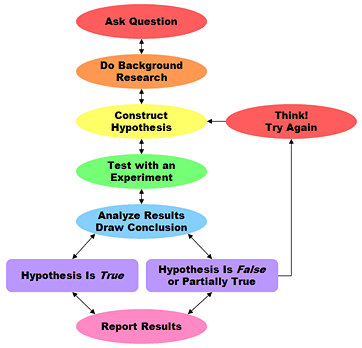
The most important part in that chart is that if your hypothesis is false or only partially true, you're supposed to stop, think, and try again. It is scientifically irresponsible, immoral and unethical to manipulate your data to achieve results that "prove" your hypothesis. This puts ego in front of fact and does an extreme disservice to science and one's audience.
Bryan Storey suggests that his professional bodies, the gatherings of members of the scientific community that regulate the way these scientists practice their professions, are the ones directing them not to follow the scientific method. The scientific method is the very first thing we learn as children about how to experiment objectively. This indicates that the fallacy of AGW runs to the highest levels of the scientific community, and that politics (and the money gained therefrom) is ultimately what is driving the decisions being made. This indicates that the majority of the scientific community, and their prophet of catastrophe, Al Gore, has decided not to stop, think, and try again when they might not be on solid ground.
But when you've got a multi-million dollar carbon-trading scheme to maintain, I guess it's too much for me to expect that anyone should actually think.
Now it's been fairly obvious to those of us that are skeptical of Anthropogenic Global Warming that nobody advocating AGW has been practicing real science, and the specific facts are now beginning to come forward as to just how egregious the evasion of practicing real science in terms of AGW has been. Fantastic evidence is provided today by the Science and Public Policy Institute in a report titled "United States & Global Data Integrity Issues." (Hat Tip to Tamron in LGF's spinoff links)
The report discusses the in depth research being done on a voluntary basis by Anthony Watts, which you can view for yourself at surfacestations.org and at wattsupwiththat.com. Watts is in the process of discrediting the actual source data that has been compiled from over 1,200 temperature stations across the United States. He's currently two-thirds of the way through cataloguing their locations and histories, and so far the vast majority of the stations have been showed to be located in spots that are excessively and abnormally hot, such as in the middle of asphalt parking lots, or next to air conditioning unit condensers. In some cases, the histories of the units show that as the concept of AGW began to be politicized, the units were actually moved from more appropriate grassy locations to these abnormally hotter locations.
We are beginning to find that, much more than being just a movement with religious overtones, that the concept of AGW has been an outright lie even from the start. The concept of GIGO (garbage-in, garbage-out) applies to any dataset analysis, no matter how large. And this is even further reinforced by Al Gore and his people today.
Timothy Birdnow points to a CCNET report today about a debate over AGW, sponsored by Christchurch's Avenues magazine, that featured Gerrit van der Lingen and Bryan Storey. The main part of Birnow's post is the following:
Now, I haven't had to do experimentation via the scientific method in a while, but I'm pretty sure I distincly remember that if you get results that are debatable, you're supposed to discuss the different options as much as possible and rethink your tests. Looking it up, it seems my recollection is correct:In Dr van der Lingen’s argument, he made the observation that Al Gore refuses to debate the points in his film, An Inconvenient Truth. In Professor Storey’s response he said, quote:
“Our professional bodies recommend that we do not publicly engage in debates over climate change as it gives a platform for the vocal minority to express their views, often scientifically incorrect or carefully selected to distort a longer term trend. This will undoubtedly be the advice that the former US Vice President Al Gore will have received, influencing his decision not to engage in televised debates.”
The most important part in that chart is that if your hypothesis is false or only partially true, you're supposed to stop, think, and try again. It is scientifically irresponsible, immoral and unethical to manipulate your data to achieve results that "prove" your hypothesis. This puts ego in front of fact and does an extreme disservice to science and one's audience.
Bryan Storey suggests that his professional bodies, the gatherings of members of the scientific community that regulate the way these scientists practice their professions, are the ones directing them not to follow the scientific method. The scientific method is the very first thing we learn as children about how to experiment objectively. This indicates that the fallacy of AGW runs to the highest levels of the scientific community, and that politics (and the money gained therefrom) is ultimately what is driving the decisions being made. This indicates that the majority of the scientific community, and their prophet of catastrophe, Al Gore, has decided not to stop, think, and try again when they might not be on solid ground.
But when you've got a multi-million dollar carbon-trading scheme to maintain, I guess it's too much for me to expect that anyone should actually think.
Subscribe to:
Posts (Atom)

 Posts
Posts


