Showing posts with label Officially the Future. Show all posts

Friday, January 22, 2010

Why It's officially the future #MEAT


Alright, So I've been slacking rather magnificently on this posting business. But I assure you, it's completely someone else's fault.

While I figure out just who to blame, here's some nifty proof that we are indeed living in the future.

Meat Band aids.

A nice article on these things was up on Gizmodo back in November. (Here) The company PR guy said he doesn't really like the term 'meat band aids' but it's fairly accurate. A band aid is an artificial scab one uses to cover and close a wound more expediently than the normal healing process would allow. However we all know the dangers of band aids - ie taking them off. As the artificial scab holds its position, the regular scab grows and accumulates under and eventually into the bandage its self. When the bandage needs to be removed, the scab and some of the replacement tissue ends up going with it. So in a vein of thought similar to that of the dissolving stitches used for surgery, someone thought up the meat band aid.

Basically, you create a little patch of synthetic tissue (using those evil evil stem cells) that won't be rejected by the patient's immune system and you slap it on the wound - typically an ulcerous or venomous wound, something that isn't healing on its own for whatever reason. After a little while the synthetic patch adheres and bonds with the living tissue surrounding the wound, and the wound stops... being a wound.

Its made by a company called Apligraf, and unlike a few other researchers (and even a whole company or two) their goal is not custom-tailored replacement organs (rejoice! ye sinful smokers and drinkers [with $12Million to spend on new organs!]) but rather mass-produced synthetic tissue.

And that's why it's officially the future, dear readers. There is officially a company in existence who's main goal is mass-production of synthetic tissues suitable for human use.

But probably not for human consumption.

Waking the Dead

Not that I am one to talk about slacking on one's blogging, but I find it hard to believe I actually beat ZephOmega to this one, so allow me to gloat with a slight chortle, as I bring you another installment "Why It's Officially the Future" before he does. Folks, we are moving ever closer to becoming Borg, as scientists have begun using machines for the purpose of waking the dead:

Surgeons made cadavers blink with artificial muscles, experiments that could in the future help restore the ability of thousands of patients with facial paralysis to open and close their eyes on their own.

If that weren't cool enough, let's remember that medicine in general already has two methods for fixing the condition of being unable to blink.

Without lubrication from the blinking lid, the eye can develop ulcers and the person can eventually go blind. Currently, eyelid paralysis is treated by one of two approaches. One is to transfer a muscle from the leg into face. However, this option requires six to 10 hours of surgery, creates a wound that can impair the body elsewhere, and is not always suitable for elderly or medically fragile patients.

"I would estimate under 100 of those are done in the United States every year," said researcher Craig Senders, an otolaryngologist at the University of California at Davis. The other treatment involves suturing a small gold weight inside the eyelid, which helps close the eye with the aid of gravity. Although such therapy is successful in more than 90 percent of patients, the resulting blink is slower than normal and cannot be synchronized with the opposite eye, and some patients also have a hard time keeping the weighted lid closed when lying down to sleep.

In the United States, roughly 3,000 to 5,000 patients undergo this surgery every year.

Now, though I did beat ZephOmega to this information, I'm certainly not him in that I don't look at stuff like this for the sake of it being interesting. So while it does happen to be cool as hell, I've got to be the one to point out that this is the kind of stuff that comes out of our current, capitalistic healthcare system.

"But...but...the people that figured this out are scientists at UC Davis, a public university. That's not part of your precious capitalism at all!"

Forgive me for bogarting Glenn Beck's Arguing with Idiots format, but it's very useful. Yes, those are public monies funding research at a public university. But that's not what makes this a capitalist discovery. What makes this discovery part of our successful capitalist way of doing things, is that somebody somewhere figured this out, and now it is available for others to put to good use. It is the same logic behind the infamous short essay, "I, Pencil," that outlines the enormously complex process by which a pencil is assembled and brought to you in the store for pocket change.

What also makes this part of our successful capitalist way of doing things is that, if you might imagine for a moment a government panel of some sort in charge of directing research & development looking over some eager scientist's application for funds to begin work on this artificial muscle project, what would be the panel's impetus to even approve the application? They would look at the fact that there are already two ways to solve this problem, and that the number of cases in total is fairly low per year on the whole, and would decide that funding to begin this research is not economically viable for the system.

Instead, we have a system where somebody somewhere, in this case UC Davis, decided that it was worth the expense to have their staff research this problem and create an even better solution than already existed. Yes, it was a public university using public funds. However, the decision was made in an effort to improve not only medicine, but the image of the university as well. This is the rational self interest by which capitalism drives innovation, even when public money is involved. No consideration to the health of the entire system was given because none needed to be. Only if our health system is ever centralized under governmental authority will we see innovation such as this disappear.

Thursday, April 23, 2009

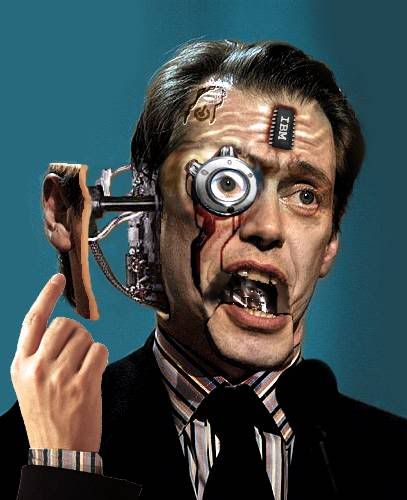
Why it's officially the future #46: Cyborgs


Cyborgs.


There are cyborgs among us. Most do not look at all like cyborgs - hulking abominations of flesh and machine wrought into existence by a cackling madman in a white lab coat - indeed, you yourself may be a cyborg without even knowing it (But don't worry, I don't mean in a creepy amnesiatic manchurian candidate sleeper cell kind of way). A Cyborg is simply a living being who's body has been purposefully augmented by some technological means, often with some part of the body replaced with an artificial component

There are of course different levels, or 'classes' of cyborg based on the amount and intention of the modification, and a quick explanation of each follows.


-=Note=-

For this argument to make more sense, think of yourself as a character in an RPG [role playing game]. Or pretend that your resume has a 'stats sheet' listing your strength, speed, agility, intelligence etc. as some value from 1 to 20, with the absolute peak of human perfection being someone with 20's across the board.


Class 1: A Class 1, or restorative cyborg is a person who's physical or mental capabilities are for one reason or another less than the human norm and has thus been modified in order to raise said capabilities back to normal human levels.

Good examples of Class1's are people who are without the use (or in some cases the presence) of their legs, and instead have artificial legs of one type or another. Anyone with an artificial heart valve or indeed an artificial heart is a Class1. I myself am a Class1, as a team of doctors installed a permanent metal staple into the bottom of my jaw after it was broken a few years ago - the idea being that the staple would help restore some of the structural integrity that was lost when the bones were first broken. Not to mention that I have fillings in at least a few of my teeth (as I imagine you, dear reader, do as well). Anyone who wears glasses or contacts, or who has had laser eye surgery is a Class1.

[EDIT: disregard the comment on glasses and contacts, as they are non-perminant and non-internal, and if they are counted as Class1, so would "that nifty 'augmentation': clothes." - Nate Smars]

When you think Class 1 cyborgs, think of the modification as restoring something that was lost. (Someone who had 12 speed but broke their leg and went down to 9, then used some form of tech to bump themselves back up to 12.)


Class 2: Upon reaching the definition of the Class2 we move officially into the realm of the nifty, and in many people's minds into the realm of science fiction. A Class2 Cyborg is again someone who's abilities were sub par, but have since been modified in such a way that they are left 'ahead of the game' so to speak. One of the most well known fictional examples of a Class2 in popular culture would have to be Geordi La Forge from Star Trek: The Next Generation. His character (for those of you who somehow don't already know) was born blind. However with the use of that spiffy visor of his he is able to see not only the usual EM spectrum that humans are sensitive to, but numerous other types of radiation as well as anything else the writers had need of.

For those of you more fond of pop culture fantasy rather than SciFi - think Mad-eye Moody from the Potter series. He replaced the normal eye he lost with a magical eyeball construct that could rotate and swivel more freely than a normal eye, as well as see through the back or sides of his own head (and probably any other matter if he really wanted). Mad-eye is therefore one of the few Class2 Cyborgs in the Harry Potter series.

A perfect example of a Class2 in real life is Oscar Pistorius, the so called 'fastest man on no legs.' Oscar is a double-amputee who's personal best of 46:25 in the 400 meter brought him juuuust short of the 45:55 qualifying time for the 2008 summer Olympics. But while there were certainly countless athletes who found themselves just that tiny bit short of qualifying, none of them but Oscar could ensure they made the qualifying run next time by calling a design firm and ordering a faster pair of legs.

In a nutshell, Class 2 cyborgs are still replacing something that was lost, but the replacement (either intentionally or not) ends up being better than what was being replaced. (instead of the tech restoring them to a 12, they end up at 14)


Class 3: And finally we reach the Class 3 cyborg, the 'true' cyborg. A class3 is someone who willingly modifies him or herself [or is modified on behalf of someone else's will] with the intent of becoming something more than they were before. There may be nothing wrong with a Class3 before they are modified, no physical or mental detriment that is being compensated for. Were I to replace my eyes with cybernetic implants just because I think it'd be cool as hell, I would be a Class3.

Back to Trek examples, the Borg are Class3s. While the individual may not be all too willing to be assimilated, the intention is still to improve on the existing biological system.

One real-life example of a Class3 is the UK's own Kevin Warwick. Warwick is not by any means one of the planet's most prominent Class3s, though. Any human female who has chosen to control her own reproductive cycle by modifying her own body's hormone balance[any chick on the pill] is a Class 3 Cyborg. She has significantly modified her own body for her own gain (ok, for her bumperbudy's gain as well).

Class 3 cyborgs are not making up for any prior loss or lack with their modifications, and are instead modifying themselves purely to become better than they were. (skipping the step of breaking their leg and going strait for the modifying tech to change their speed from 12 to 14 just so they can be faster.)


Class 4: The class 4 cyborg is not defined by intent or resulting abilities due to the modification the individual has undergone, but rather by end result and % of surviving original tissue. A Class4 is at least 51% artificial. Think Robocop here.

Once we pass the 51% mark the individual can be just a human brain in an artificial body (the most extreme 'upgrade' possible) and would still be a Class4. Only barely defined as human, Class4's are a long way off but still kinda spooky to think about.


So go now, and look with your newly educated eyes at this world filled with cyborgs. And be sure to call me as soon as you hear about anywhere that's looking into cyber-eye implants.


Good god I want robot eyes...


Thursday, April 9, 2009

Why It's Officially the Future #01

This is the beginning of a series of posts that I hope will help illuminate for you, dear reader, our current state of scientific understanding and achievement in areas that have generally eluded common knowledge, but are now very quickly becoming part of our everyday lives, and are clinching proof that while we may lack flying cars, we none the less officially live in the future.

First, watch this video from Juan Enriquez's latest TED talk. It should give you a good idea of where we are in understanding life as a set of mechanical systems. Such understanding has eluded us for ages because as Douglas Adams put it years ago 'We have always preceded from the idea that to learn how something works, we take it apart. However as soon as you take apart a cat, the first thing you have on your hands is a non-working cat. Life is an order of complexity so far above our understanding that we have classically assigned a mystical explination to account for its existence.'

This holds true to the idea that religion is just a standing explanation for things we don't fully understand yet. It's a placeholder, like the incomplete special effects on the leaked version of the new 'X-men Origins: Wolverine' movie ... or so I'm told. However our science has now progressed enough that while we don't understand conscious thought and all this sentience crap just yet, we do understand how cells and DNA interact and function like the hardware and software of a computer (respectively). We can, and indeed have manufactured life at the cellular level, as well as what amounts to 'replacement parts' for our own bodies. Such advancements have only been possible because of our understanding of how life functions at the most basic level.

This understanding began with Darwin and On the Origin of Species, and really got going with Watson and Crick's (slightly stolen) discovery of DNA. But our approach was still governed by the idea of an intelligent and deliberate creator. A 'top-down' system of complexity.

[there is a famous explanation of the universe that has turtles 'all the way down' but logically, a universe created by a god of some kind raises the question of the god's creation, and leads one to the conclusion that in such a system there are 'gods all the way up']

But with the advent of modern computing and the way in which software works, we began to see that all the marvelous complexity and beauty around us could be explained from a perspective of 'bottom up' design. No matter how complex the computer program, it all begins with adding 1 and 1 and testing the result. And then doing it again. 'Ones and zeros' as my father says whenever I try to explain a complex technological concept. With an observable model like software, we can see that very very simple actions, iterated many times over, can lead to very very complex results.

This ideological bombshell has not quite created the stir that it rightfully should, but it has changed the way that I look at the world, as well as the way any fervent fans of Douglas Adams surely have. (if this whole things smacks of his speech to the Cambridge Scientific Society it's because its completely riped off from it) So the 'miracle' of life has lost its mystic explination. As its put in the above video, 'life happens.' Software and Hardware, just following a set of rules and acting as they always have.

We are just beginning to be able to understand and modify life at not only its most basic level (cells) but also at the tissue, and almost organ levels. Just how we decide to modify or even replace these particular aspects of ourselves and other living organisms, I'll cover in another post. For now just let this information stew in your mind for a little while.

We no longer need to rebuild him. We have the technology. We can regrow him. Make him better, if he wants, faster, if he so chooses, stronger, if he sees the need. Or we can bring him back to just how he was before.